CASCINA PENNA CURRADO 2024-June LUNCH at ACQUERELLO in San
Francisco


Our friends Elena Penna and Luca Currado had been running
Luca's family winery, Vietti, since the early 1990s.
We knew Luca's parents, Alfredo Currado and Luciana Vietti since the very early
1980s as they had visited San Francisco to promote their Piemontese wines.
The wines wore distinctively artistic labels and they were of good quality along
with being well-priced.


Alfredo and Luciana were regular visitors to the United States
and having become good friends, we routinely met them at the San Francisco
Airport and took them for a "Welcome Margarita" here in Burlingame
when they came to the Bay Area to promote the Vietti wines.
Alfredo passed away in 2010, though Luca had assumed the winemaking duties in the
early 1990s.
In 2016 we were shocked to learn of the sale of Vietti, as the winery was
purchased by an American family whose fortunes had been the result of numerous
convenience stores called Kum & Go, along with a trucking company and other
investments.
We understand the Krause family sold the convenience stores and trucking company
to another enterprise in August of 2023.
The Krause family are Italophiles and had purchased the Enrico Serafino
winery in the Roero region of Piemonte...
We understand that Luca had his eyes on that property thinking it would be
helpful to have a place in the Roero region to vinify their Vietti Arneis wine.
The story gets a bit murky at this stage, but soon after the Krause family
visited Vietti and the next thing we know is there's an offer to buy the winery
and its vineyards.
The sale takes place and soon Vietti is owned by people with seriously deep
pockets.
The vineyard holdings of Vietti grew as they were able to purchase many vineyard
sites in impressive places, affording Luca the chance to make Barolo and
Barbaresco from prestigious locales. This furthered his winemaking
experiences and intimate knowledge of exceptional vineyards.
The contract of the Vietti sale obliged Luca to remain for something like five
years as manager and winemaker.
The non-compete clause ran out around 2021, we think, and ever-passionate as
Luca and Elena are, we know they had dreams of reestablishing some sort of
smaller, artisan, family winemaking business.

They kept a low profile, though, being tight-lipped about the future.
But it's difficult to keep secrets in a close-knit community and we heard they
purchased some property in the Serralunga area east of their home-base of
Castiglione Falletto.

Here's a snapshot of their new digs in Serralunga, apparently quite close to the
Fontanafredda winery.
The property is historic, having been first built in 1554 and operated as a
hospital, being part of the "Opera Pia," a sort of charitable
organization.
It's close to beautiful "downtown" Serralunga and overlooks the famed
Barolo cru of Lazzarito.
They've worked to renovate and upgrade the building and today have a
well-organized winery.
As for vineyards, they're leasing something like 13 hectares just south of
Monforte d'Alba in the Località San Sebastiano.
Località San Sebastiano is situated outside the delimited
"Barolo" appellation, about 5 miles south of their new winery and
about one mile south of the town square of Monforte.
This vineyard will provide fruit for their Dolcetto, Barbera and Nebbiolo
bottlings.
At one time this place was within the Barolo appellation, but in the 1970s the
delimited boundaries were re-drawn and growers there did not mind losing what
would become a hugely valuable name.
We gather there was a maximum amount of land covered by the Barolo appellation
and so the town of Cherasco gained the honor of having (more) Barolo vineyards,
while Monforte d'Alba shrunk a bit.
One particular vineyard site, Luca noted, had been providing better and better
fruit over the past vintages. Luca attributes this as being an effect of
climate change as what was a modest area is now capable of producing exceptional
quality.

The vineyard temperatures are moderated by cooling winds from the Alps and this,
they view, as an advantage with warmer growing seasons.
The total production of grapes will allow them to select the best and they will
likely sell a percentage of the harvest to neighboring wineries.
In addition to the San Sebastiano site they have 5 hectares within the Barolo
area with vineyards in Verduno and Monforte for their future classico
bottling along with two special, prestigious sites for upcoming single vineyard
wines.
As of this writing, they've not provided the names of those.

Elena says you can see lots of the towns within the Barolo appellation along
with Monviso, that high mountain peak covered in snow.
This has been said to be the inspiration for the Paramount logo you often see at
the start of a film.

They started from Ground Zero, not purchasing an existing winery.
"This allows us to have a fresh beginning with no chains from the
past."
While they certainly had been considering launching a new brand some years ago,
it seems everything for this project began in 2022.
"We were quickly able to put together the vineyards and winery, doing the
work it usually requires generations to accomplish."
Help from numerous friends and neighbors has been instrumental in launching the
Penna-Currado project.
Some colleagues lent, for example, some botte for maturing various wines
so Luca would avoid the dynamic of making woody wines at the start, while
needing some time for the cooperage to become properly seasoned allowing for
wines of balance.
"Our community is fantastic." Luca said.

Plans seem to include at least a trio of Barolo bottlings...We understand they
have access to vineyards from Verduno, Monforte d'Alba and Barolo for a
"classico" bottling. They are currently close-to-the-vest with
respect to cru bottlings of Barolo, but they've said there are two of those in
the works with five hectares of vineyards which have maybe 20 to 25 years of
lease agreements.
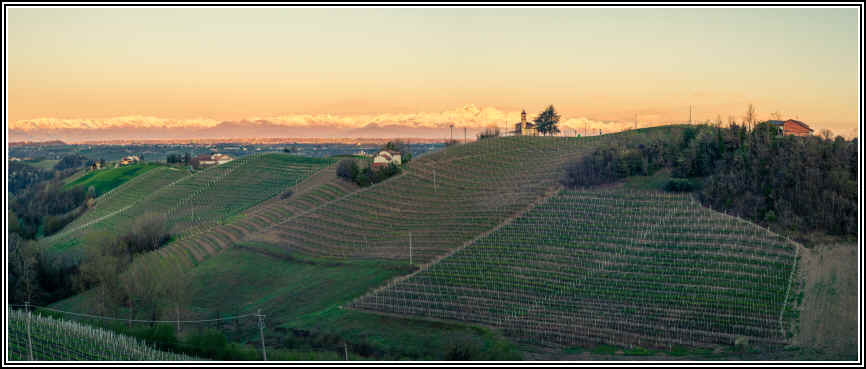
Their vineyards are farmed organically, by the way.
Luca and Elena are sensitive to the changing weather conditions.
As a result they've selected vineyards which had been located in what 20 years
ago were considered cooler, possibly marginal sites.
These days, though, the vineyards are producing wines with elegance and balance.

In mid-June of 2024 Luca and Elena visited San Francisco and we had a lovely
lunch in celebration of their new work.

The venue was the fantabulous restaurant in San Francisco called Acquerello.
They organized some terrific vittles and the wines showed beautifully.
Plus, if you've never been to Acquerello, the Paterlini family runs a superb
restaurant with great attention to detail.
It is the epitome of fine dining.


At the table we had a sneak preview of their Timorasso from a small site in the
Colli Tortonesi area in Berzano di Tortona, some 5 miles southeast of the city
of Tortona. This is close to the vineyards cultivated by Timorasso Meister
Walter Massa.
He is credited with rescuing the obscure Timorasso grape and now there are
numerous wineries making this white wine.
Luca first made Timorasso at Vietti and their purchase of vineyards in the Colli
Tortonesi was amongst the first by "foreigners" (I'm referring to
Langhe wineries).
It turns out Elena Penna is a big fan of Timorasso. In 2023 they had but
one hectare of vineyards for this, but there are 2.5 hectares being cultivated
for the 2024 harvest.
Luca employs a special vessel for maturing the wine, a Clayver, a ceramic tank
made by a wine enthusiast fellow from Genoa.
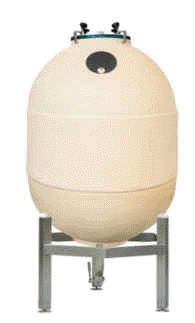
These are "fired" at temperatures roughly twice that
of terracotta and they are said to be completely neutral, whereas terracotta
(we're told) can release a small taste to the wine.
Without temperature control for these tanks, Luca keeps the Clayvers in a cold cellar.
There's a bit of skin contact and submerged cap during its fermentation.
The wine spends some months on the lees and Luca stirs these tanks periodically
to coax additional complexity out of the wine.
The 2023 tank sample we tasted had a beautiful fragrance, starting with some
subtle apple fragrances backed by a note of minerality.
Fresh and a bit stony on the palate with that hint of melon and lightly citrusy
notes, as the wine got some air and warmed a bit, it reminded me of some French
wines.
Then I remembered that Luca and Elena have numerous vintner friends in Burgundy
and I remarked that I thought he was being influenced by these French
winemakers.
His eyes lit up and he smiled, nodding that my observation was astute.

Next was the Cascina Penna-Currado 2022 Dolcetto d'Alba "Bricco Lago."
This comes from a one hectare vineyard, though they will have access to 2.5
hectares in 2024 and beyond.
These vines were planted in 1964 and 1974. They view this as a classic
"entry level" red wine for those just discovering Piemonte as it's
representative of the Langhe region. Luca includes some whole clusters in
the tank, but says this is not "carbonic maceration" in terms of its
fermentation.
Stainless steel only...no wood aging.
It's beautifully fragrant, displaying lots of red fruit aromas and a mild floral
tone. Medium+ in body and there's a light touch of tannin, but it's
clearly intended for drinking in its youth. Some people describe Dolcetto
as being akin to French Beaujolais.
We find more dark cherry notes here compared to Beaujolais' strawberry
fruitiness.
Plus it's fuller bodied than most Beaujolais.

Barbera has been a long-time favorite of Luca as he made numerous stellar
bottlings at Vietti.
This 2022 carries the Carrà designation, coming from two vineyards in the San
Sebastiano area outside Monforte d'Alba.
One parcel was planted in the mid-1960s and the other in 2000. Partially
whole cluster fermented and then it's aged in botti (large vats).
This started slowly in the glass but seems to blossom nicely with aeration...30
minutes in the glass and the aromas displayed a dark berry fruit and hint of
spiciness.
We mentioned to Luca that our personal preference is for a shade more influence
from a barrel.
"Yes, I remember." he said.
Not that the wine needs a lot of wood...but a touch more oak would distinguish
this more from the Dolcetto and Nebbiolo bottlings.

The 2022 Langhe Nebbiolo carries the Bricco Lago designation.

Luca again spoke of how these vines, from Monforte d'Alba, are outside the
Barolo appellation.
At one point in time this was viewed as a marginal site for Nebbiolo, as back in
the Dark Ages growers would cultivate the maximum allowable yields, making it a
challenge to getting the fruit to a proper degree of ripeness
With greater care and limiting the crop level, it's possible to obtain better
quality fruit.
"Now it is making very interesting
wine." Luca explained.
And Luca would know, having vinified fruit from this site over the past
decade, or so.
Bricco Lago is the designation on the label as the vineyard is close to what
we're told is the only natural lake (lago) in the Langhe.
It's a small pond, in our view, not precisely the size of an actual lake.
The vines were planted in the 1970s and 1980s, so they are certainly mature now.
The Nebbiolo had a cold maceration period and Luca included whole berries, but
not whole clusters. The wine spent 8 to 12 months in barrel.
It's a good example of Nebbiolo which Luca described as important to be able to
offer a sensibly-priced wine in hopes of cultivating a market for Barolo and
Barbaresco wines.
"We need to have good entry level wines to attract new customers." he
explained, sounding to these ears a lot like his father Alfredo Currado.
Cascina Penna-Currado 2022 Langhe Nebbiolo "Bricco Lago" has the
typical light color, with a garnet/brickish hue. The aromatics displayed
some cherry-like notes and a hint of florality.
The tannin level is fairly mild, so it's certainly drinkable now but should
evolve nicely into the early 2030s.
The wine had nice intensity of flavor and had a bit of length which should
extend over the coming years with bottle aging.
The primo piatto was Lamb Tartare.

The Lamb came from the Anderson Ranch, which we believe is located in Oregon's
Willamette Valley...
Lamb Tartare with green peppercorns and artichoke.
This was delicious and you might expect it to be gamey.
It was not...very fine.
Next on the menu was Veal Tortelloni with Sweetbreads and Fava Beans.

This was also exceptional and it allowed all the wines to shine.
They then brought out a wine Luca made from the 2018 Vintage.

Monvigliero is a cru in the environs of Verduno. It's been the ambassador
for Verduno area Barolo.
This cru, back in the 1980s and 1990s, got little attention, as its wines were
usually a bit shy in terms of personality.
As the growing seasons have been warmer in the past decade, or so, you'll now
find various Monvigliero bottlings to have more character and greater
complexity.
Luca saw this wine from vineyard to bottling and it's a most elegant Barolo.
Tasted now at 5+ years of age from magnum, this was a delight...nice red fruit
aromas with perhaps a note of cherry and raspberry with a mildly tannic
finish. That little bit of astringency vanished when paired with the
Sweetbreads and Tortelloni.
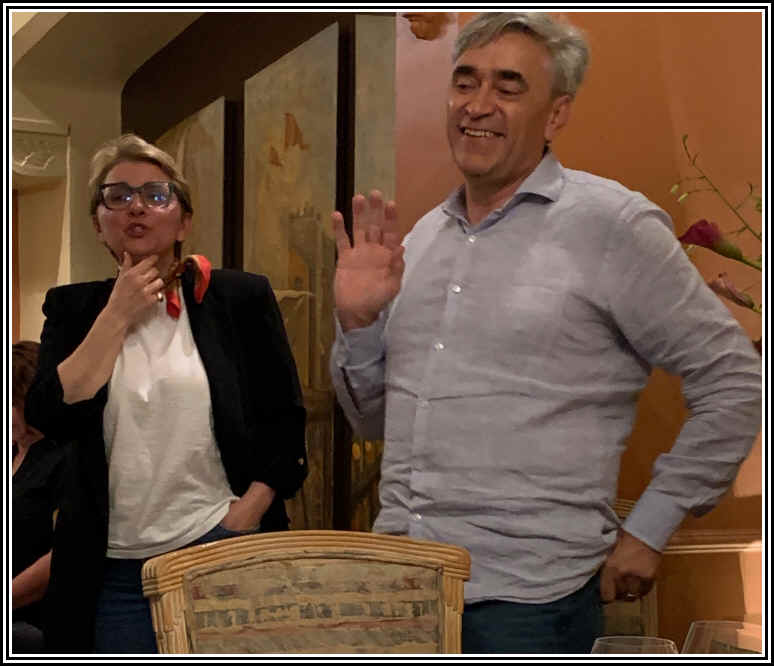
Elena and Luca spoke a bit more about their new chapter and the adventurous
journey they're on.
These are two of the most humble and down-to-earth wine-industry rock stars you
can hope to meet.
And then a serious treat was uncorked.


1985 Barolo from the famous Rocche cru, now precisely Rocche di Castiglione.
The cru is perhaps about 16 hectares (40 acres roughly) with a small part of
this cru being now solely in Castiglione Falletto, but nudging into Monforte
d'Alba, too.
I believe this cru and Villero were Alfredo's favorite and he routinely made
wonderful wines from both sites.
This 1985 was sensational and it brought a bit of emotion as this was an
eloquent statement from Alfredo.
You can see the brickish color in the glass above...the wine had stellar
fragrances of not just Nebbiolo, but of Nebbiolo from the Rocche site and
Nebbiolo from the Rocche cru made by Alfredo Currado.
Luca was just a teenager when this wine was made!
There were classic notes reminiscent a bit of rose petals, a touch of a truffle
character and a suggestion of the tarry elements that emerge when Barolo is
mature. And despite its age, just north of 38 years, the wine still has a
lot of life to it.
This was a real treat and, we hope, a preview of the wines Luca will make under
their Cascina Penna-Currado label.
But we will have to wait until, what?, 2055 to 2060 to see.
Dessert?

For me, some sort of Almond Sablé with blueberries and Meyer Lemon.

For others: Testun al Barolo, Castelmagno and Toma Valsesia with almond-filled
dates, figs and Sultanas.
Chef Suzette Gresham gave information about each of the
specially-curated cheeses served to most of the guests.

The Chef de Cuisine, by the way, was Seth Turiansky.

Having had such a splendid remembrance of our dear friend Alfredo Currado, we
gifted both Elena and Luca with special Alfredo shirts.

Then, to finish on a sweet note, guests were offered another
sweet treat to go with their coffee.

This was a beautiful introduction to Cascina Penna-Currado....
*****************************************
Having been reminded how good those Barolo wines of Luca and
Alfredo were, we opened a nicely aged bottle some days after this event.

It was exceptional.
Many thanks for the invitation to taste the new wines!
We have, as of July 2024, a few bottles of the Cascina Penna-Currado wines in
the shop:
2022 Dolcetto d'Alba $36.99
2022 Barbera d'Alba $44.99
2022 Langhe Nebbiolo $49.99
BACK TO OUR HOME
PAGE


